
Agentic Payments: When AI Starts Buying for Us
AI assistants are moving beyond answering questions. They are beginning to make purchases, and this could change how the internet economy works.
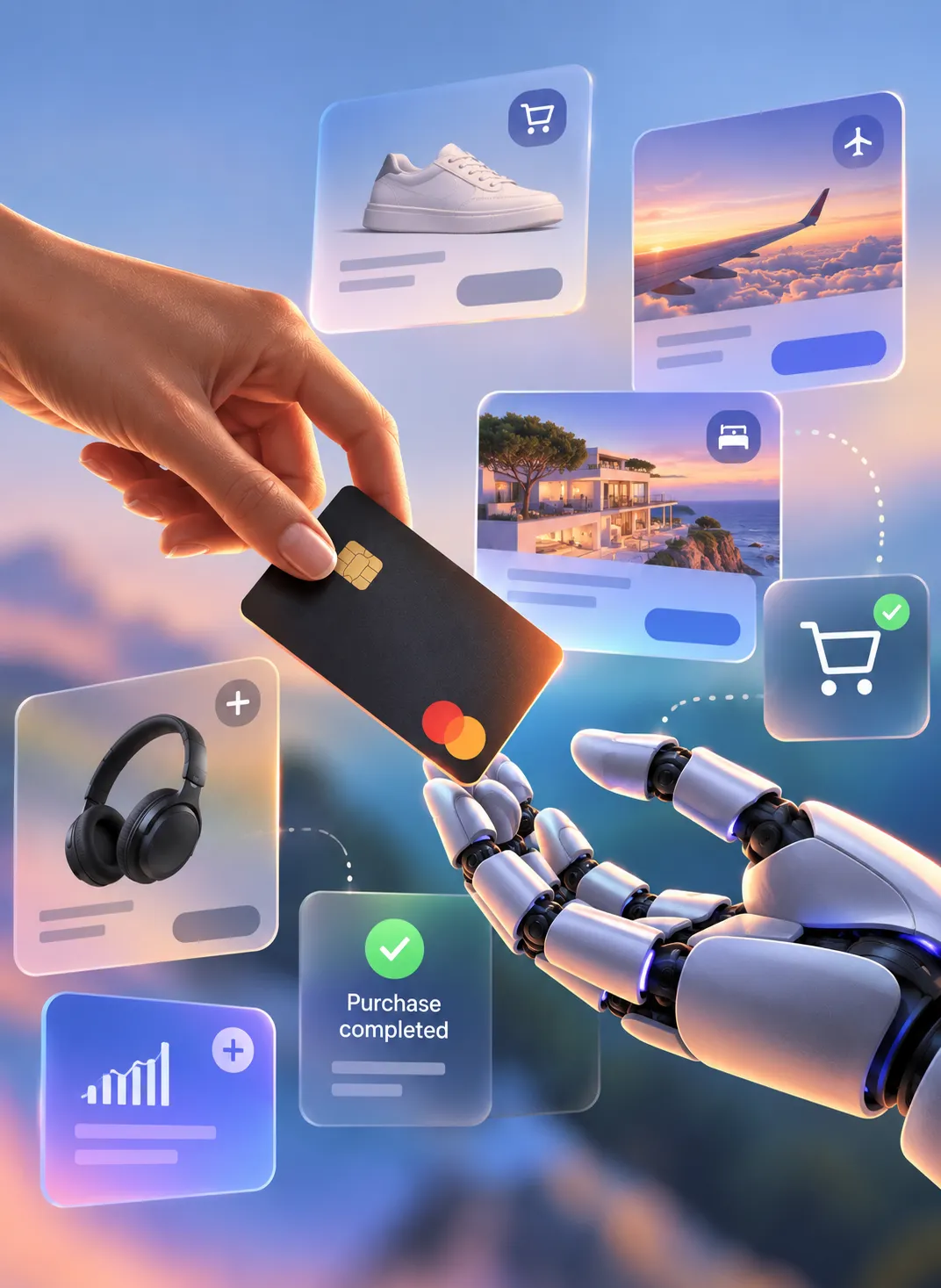
Nowadays, we are hearing more and more about AI assistants capable of doing much more than answering questions. They can search the web, visit websites, compare products, and even make purchases on our behalf.
This evolution marks an important shift: AI is moving from providing information to taking action.
The Turning Point Today, almost everyone can have a virtual assistant capable of performing tasks that previously required human assistance.
However, one key feature has remained a challenge: payments.
Payments are different from other tasks because they involve direct access to personal or company finances. Until now, purchasing decisions have generally required human approval.
Computers could execute orders, track purchases, handle deliveries, and send notifications. But humans were still the ones clicking the purchase button and entering their credit card details.
This is the barrier agentic payments are beginning to remove.
What Are Agentic Payments? Agentic payments allow AI agents to initiate and execute purchases on behalf of users, within predefined limits.
An agent can search the web, check availability, compare products, and complete a transaction.
For companies, the possibilities are even greater.
AI agents could monitor stock levels, compare suppliers, negotiate prices, and make purchasing decisions based on available data. Instead of employees constantly checking prices and placing orders, an agent could monitor the market over long periods and buy at the most advantageous moment.
In some cases, this could automate decisions that currently require several people.
But agentic payments are not limited to physical goods.
They could also transform how information is exchanged online.
For example, an AI agent might need additional data to complete an analysis, such as weather forecasts, stock prices, or specialized research. Instead of requiring a human to purchase access, the agent could pay directly for the information it needs.
This opens the door to a new form of commerce: machines buying services from other machines.
How Do Agentic Payments Work? The process begins with a mandate: a person gives the agent an instruction.
For example: “Find and book a flight to New York for less than €500.”
The agent searches for available flights, compares prices, and selects the best option according to the user’s criteria.
To complete the purchase, it uses a secure payment credential, such as a token, with permissions defined by the user.
In simple terms, the agent needs access to an authorized payment method, such as a card or digital wallet, without necessarily having direct access to the user’s banking details.
Once the transaction meets the authorization requirements, the payment can be executed and recorded.
The goal is simple: allow AI to make purchases while keeping humans in control of the money.
The Risks Giving AI the ability to purchase goods also introduces significant risks.
First, an agent could get stuck in a loop and repeatedly purchase the same product. Without spending limits, a simple error could become expensive.
Another concern is cybersecurity.
Hackers could use prompt injection to manipulate an agent through malicious instructions hidden on websites or in other content. This could potentially lead to unauthorized purchases.
There is also the question of responsibility: who is accountable when an AI makes the wrong purchasing decision?
This is why agentic payments need strict permissions, spending limits, and security controls.
The challenge is not just making AI capable of spending money, but making sure it spends money safely.
Final Thoughts: Which Stocks Could Benefit? As agentic payments develop, some companies could benefit from building the infrastructure behind this new market.
Three are particularly interesting to watch:
Coinbase (COIN)
Coinbase developed x402, an open payment protocol that allows AI agents to pay for APIs, data, and online services. It could become an important part of machine-to-machine payments.
Cloudflare (NET)
Cloudflare is working with Coinbase on x402, helping developers integrate payments into online services. Its existing internet infrastructure could give it an advantage.
Circle (CRCL)
Circle is the company behind USDC, a stablecoin that can be used for programmable payments. As autonomous transactions grow, demand for this type of infrastructure could increase.
These companies offer different ways to gain exposure to agentic payments, although the growth of this technology does not guarantee rising stock prices.
The next transformation of the internet may not be about humans buying online, but machines buying from other machines.